New Meshtastic Routers – Apollo and Pine Ridge
Before I entered my current career 3 years ago, I worked for a company which owns a less than a dozen high-profile tower sites across the Allegheny, Westmoreland, Butler, Armstrong, and Indiana counties. I still do work for them sometimes by climbing their towers for preventative maintenance or repairs. When performing these duties, some excellent opportunities arise in my favor to improve the mesh by installing high-profile nodes on them.
I feel that with my skill set and resources at my disposal, I have somewhat of a obligation to help the mesh in the best way I can – which in this case has presented itself in quite the outstanding way.
My first opportunity was a few months back in mid-March. The weather had been dry the past few days, and surprisingly warm for the time of year. Sounded to me like the perfect day to install a router I had prepped just for the occasion. Admittedly, there was already a node on this tower, but I had installed it improperly and it was unstable. Didn’t work at all in fact, because I forgot to enable LoRa TX before climbing down. Yeah… whoops.
But now the weather had changed for one of the first times of the new year, and I had the chance to reinstall that node and witness the real footprint that was possible with this site.
The site in question is located in Apollo, PA. There is a prominent hilltop with two structures in use. The taller of the two – I have access to. On top of this structure is a Verizon cellular rack operating at up to 890 MHz. This frequency is really close to the 906 MHz our mesh operates within. The cellular also transmits at around 150 watts EIRP, so It is truly in our best interest to keep as far away from it as is reasonable with our measly 100 mW and marginal adjacent channel rejection. The good news about most cellular racks on the towers like this, is they are usually run using sector antennas, not omnidirectional. This means most of the RF is sent outward, and minimal is sent directly below. Since we will be mounting our equipment directly below the racks, we can actually remain rather close (< 100 ft) and still have a receiver with a reasonable amount of sensitivity left over.
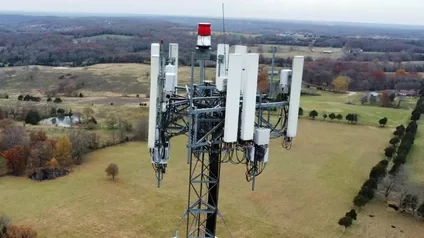
So the site In question is looking like a great candidate. I packed up my gear, and left for the site. It was a beautiful, sunny day and I think the temperature was around 65. There were some strong gusts, but otherwise It was a gorgeous day for a climb. My friend even came out with their drone to grab some shots of me climbing the tower. All around good times were had.
I climbed the tower to an altitude of about 200ft AGL. Relative to sea level, this node ended up placed at an altitude of 521M MSL, or 1710 ft. MSL.
I installed the node with an ALFA 915 antenna, a RAK 4631 on a WizBlock, and a (very cheap) USB solar panel wired directly to the WizBlock’s solar input. As I installed the node, I quickly realized I did not have the correct hardware to mount it optimally. The only place I could secure it was directly against one of the tower legs. This has the undesired effect of coupling the RF energy to the tower leg, and therefore reducing the overall radiated power. It also causes a “blind spot” directly behind the antenna and towards the regions it faces.
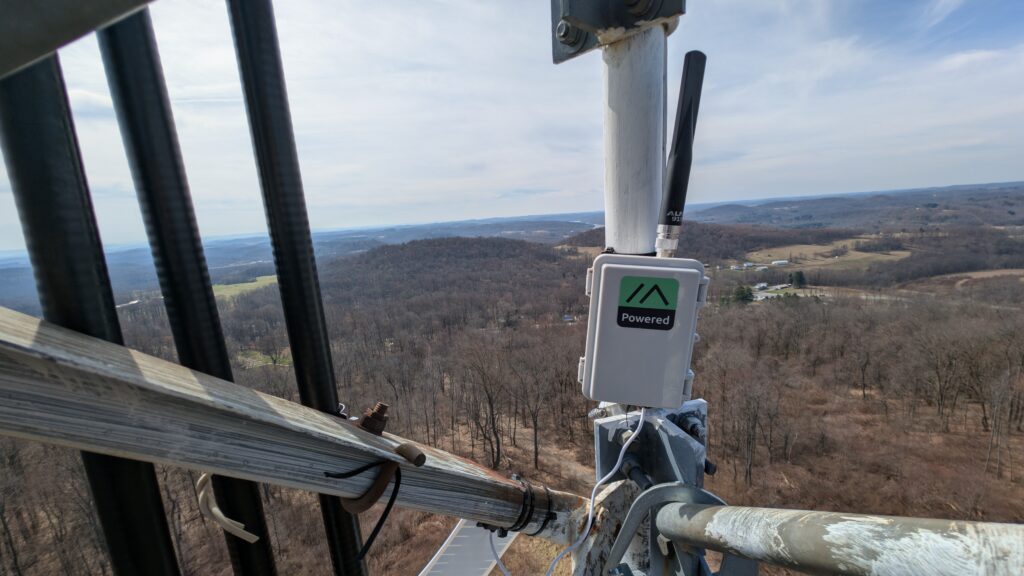
So the install looks pretty OK, but functionality-wise it is suffering a bit.
Despite that, this node has proven to be a staple in the mesh today. After adding this node, we saw some major improvements in overall connectivity, with special attention noteworthy for the connection between the Greater Pittsburgh Area, Murrysville, and Greensburg.
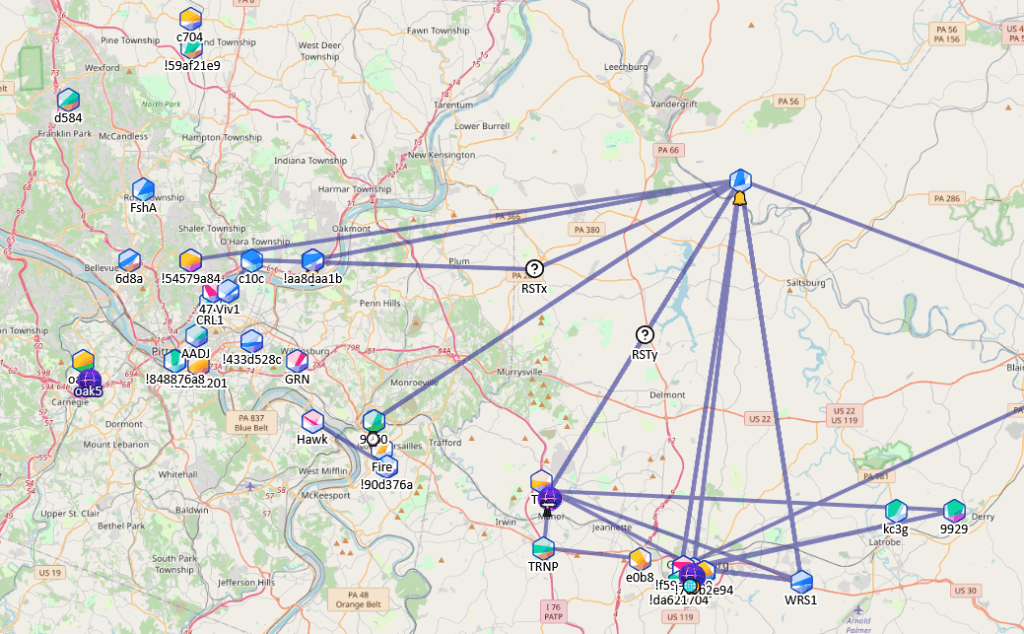
APOLLO adds some serious coverage to our mesh. It could easily be named the core of our backbone network in it’s current state. I am beyond proud of it’s performance. But I still am chomping at the bit to get back out there and install the proper hardware to make it really shine. In the meantime though, it is now a very important part of our mesh and the mesh’s performance despite the poor mounting conditions. The above map is proof of that!
Pine Ridge
This node was a troubled child from the start. Much like Apollo, I installed a node here last year but It did not work due to poor knowledge on my part. I simply wasn’t aware of how poorly the Heltec V3 boards performed on battery. They were power hogs. Once I realized switching to Rak4631 boards provided power consumption metrics on-par with 10x greater efficiency when compared to the Heltecs, I began plans to replace all of my defunct nodes which mostly didn’t work at all!
Not long after installing Apollo, I climbed a tower at the summit in Blairsville to fix some dish alignments with a new Rak4631 in tow. I also brought with me a 5.8 dBi antenna to test it’s performance. I had already done some tests at short range with it. It seemed to perform well given the limited circumstances of my short-range tests, so I found it acceptable to make a gamble and mount it. It was unbranded too – it’s performance could be wildly off from it’s spec.
Pine Ridge was installed about 100ft above ground level, at an ultimate MSL altitiude of 652 M or 2139 Ft. Wow!
I climbed down, verified the node could broadcast and also respond to my administration node and happy ole-me was on his way back down the mountain.
But this… was far from over.
Halfway down the mountain on Rt.22, I realized I couldn’t talk to the node. It wouldn’t reply to my pings, and administration wasn’t working at all. What on earth was going on!? It was JUST working! I drove back up the mountain and everything was fine. Even my RSSI and SNR was within reasonable numbers when just a few dozen feet from the tower base. What?
Then it dawned on me, about 50 ft above me (the node’s mounting height) and 200ft away was a cellular tower with Verizon, AT&T, and T-Mobile. Much like APOLLO, but in this situation the sector antennas were pointed in my direction. Since I didn’t have access to the tower these services are mounted upon, I don’t have the luxury of just mounting beneath them like with APOLLO. These cellular services were so loud that my Meshtastic node must have been deaf.
This issue led me to think, what if I could completely block out the 890 MHz band from my radio? That would surely help it hear the right frequencies. Some googling around an I found an Acasom 915 Band-Pass filter for a very reasonable price.
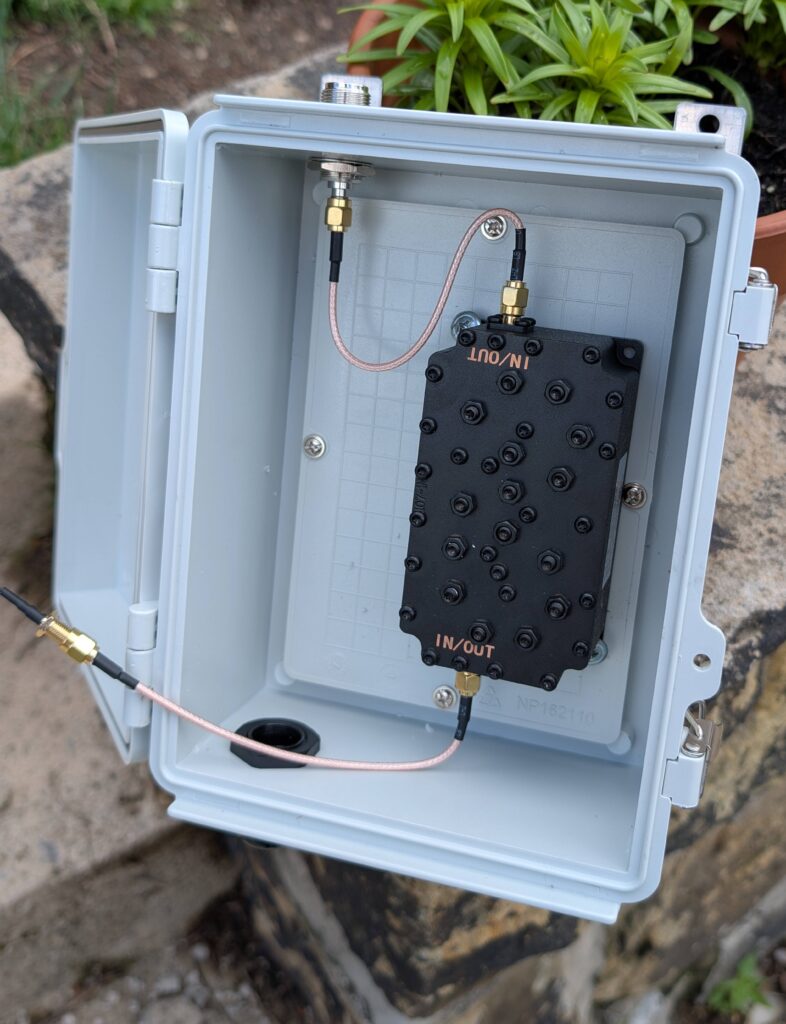
I tested it and found less than 0.8 dB of insertion loss. A very respectable number for such a low-cost filter. I drove around with it for a few days just to make sure it worked as intended and I was incredibly surprised by it’s performance. I noticed no degradation in my car-node’s performance with this filter. It’s likely this filter actually increased performance overall.
Some time passed and I had yet another opportunity arise where I could climb and install this router to finally get it working and test out the filter. As it turns out, the storms from recent weeks had gusts strong enough to knock two of our tower-network’s backhaul dishes out of alignment.
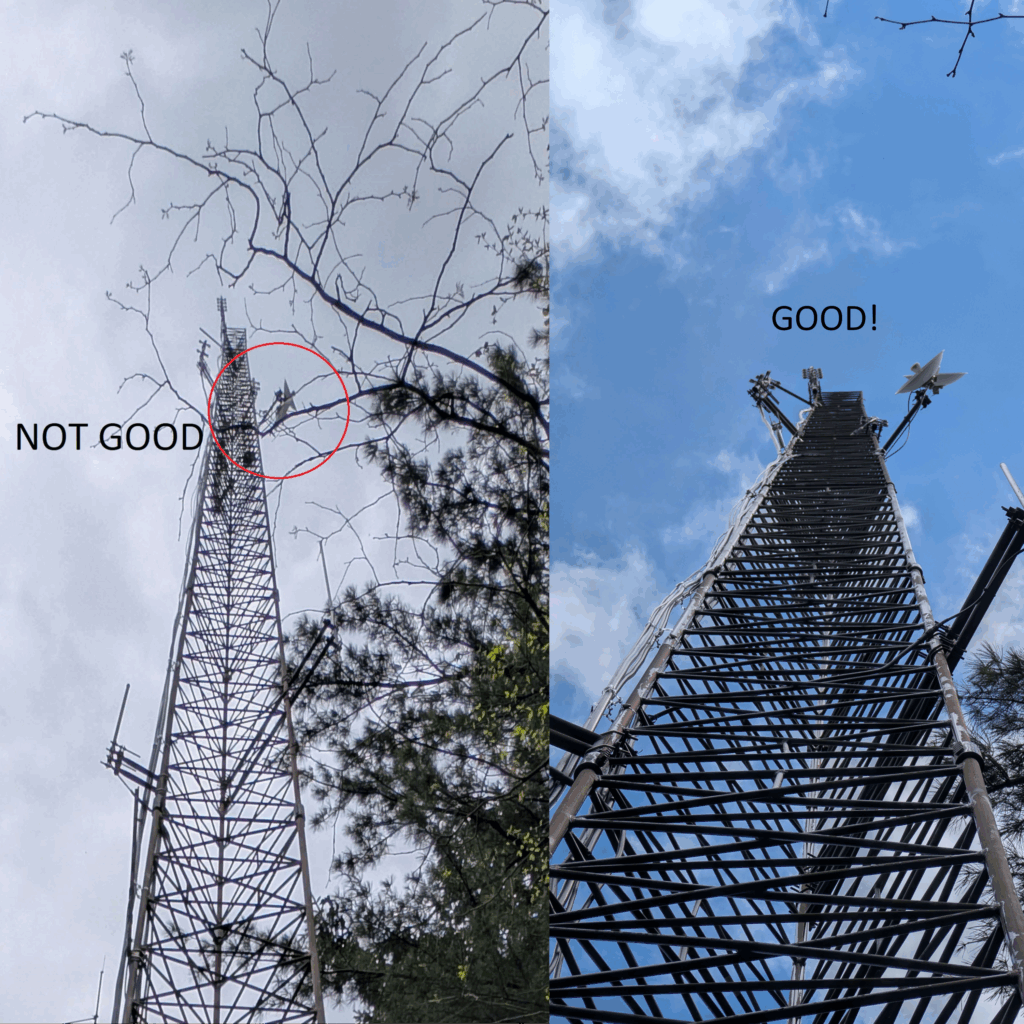
Despite the opportunity to go back to the site and fix this mesh node’s installation, boy did I choose a bad day to do it.
May 5th, 2025 was a bright and sunny day – at least, in the early hours.
What I didn’t foresee was for some smallish (foreshadowing) storm cells to pop up over Somerset and head north-west. I saw them approaching on radar before climbing, but I had a decision to make:
1. Do I wait for the rain, and potentially climb a wet tower?
2. Do I climb now, and potentially get soaked while on the tower?
3. Do I forget it and leave?
I’ll save you the guesswork. I went with option 2.
I climbed the tower, got situated at 100ft, and then the rain came immediately afterwards. I think I was up there for 40 minutes, adjusting the dishes first, and mounting the enclosure while my partner checked RSSI on them.
There was a part of the rain storm where I really considered climbing back down for safety sake, but no lightning was nearby so I just stuck it out and let the rain beat my face for 10 minutes.
I eventually got the enclosure mounted, and the rain let up just long enough I could transplant the PINE RIDGE router from it’s old box to the new. I secured it’s coax and got down off that tower as deliberately as I could.
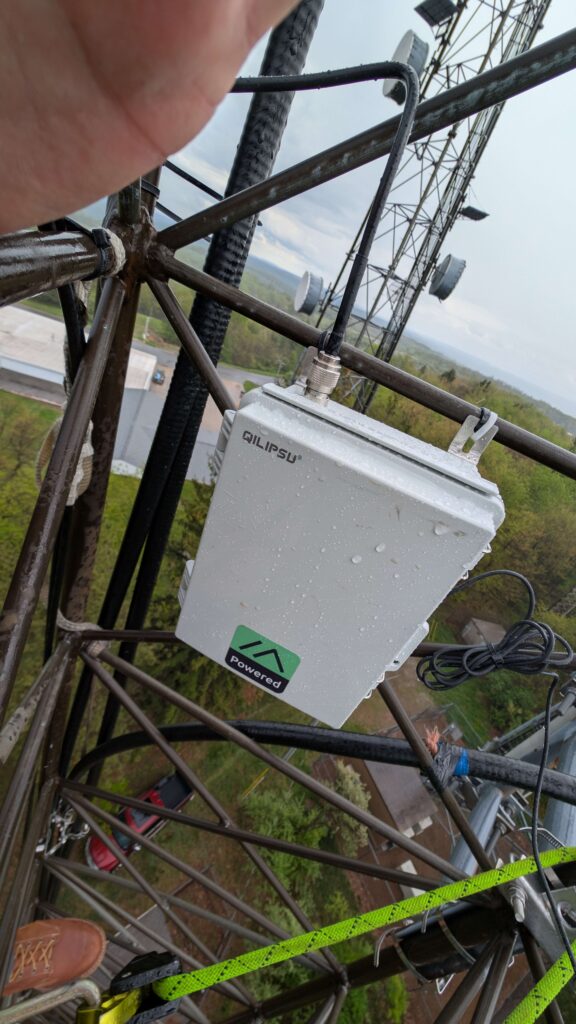
Finally! The node was installed. And I got my first confirmations it was working by some of my friends in the PGHMesh Discord. Traceroutes all the way from Pittsburgh were working consistently!
Now, we just have to wait and see who new joins the party!
Thank you for reading and following me on this journey.
I wish to continue updating this blog with more content as I move forward in the world of Meshtastic. I think this technology can be useful – and it’s fun to experiment and play along the way.
2 thoughts on “New Meshtastic Routers – Apollo and Pine Ridge”
Comments are closed.
Filed under: Project - @ May 6, 2025 6:10 am
love this post….good lord..yer pretty up there..:P
You win the day sir, the Pittsburgh mesh has been blowing up and you just added lovely gunpowder to the mix 🙂